Research reveals how changing light levels impact fish passage
How do critically endangered fish respond to river infrastructure?
River fragmentation is a major risk for fish population security. However, much of the research on fish passage has focused on the physical impacts of larger-scale river barriers such as dams and weirs.
Ben Bluck, a PhD student at the University of Southampton, is researching the effects of culverts as behavioural barriers to fish passage and how fish respond to the rapid light transitions at culvert entrances.
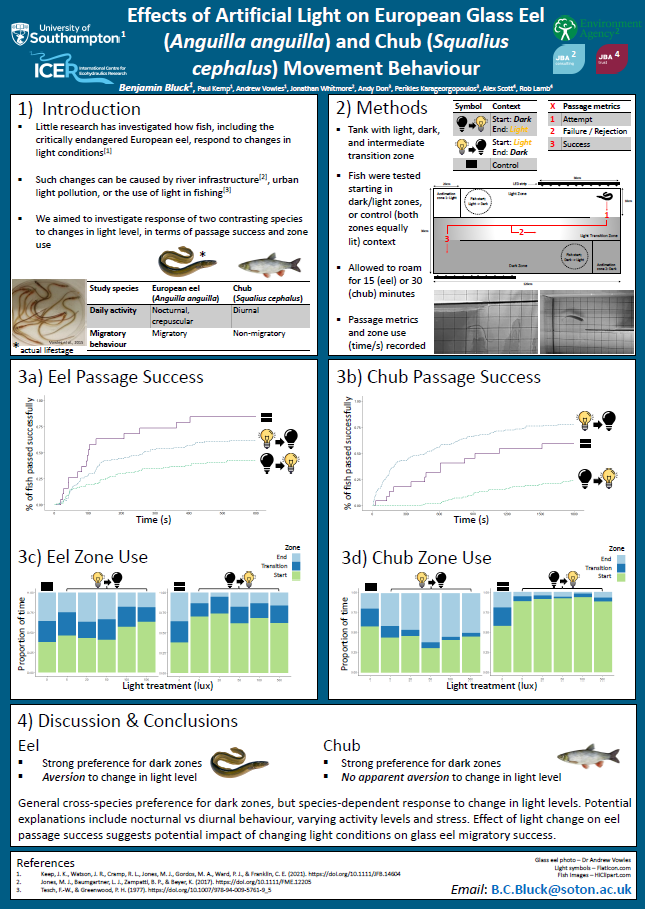
Through behavioural choice experiments and passage success assessments, Ben’s research investigated the response of two contrasting species to changes in light level, the critically endangered European Glass Eel (Anguilla anguilla) and Chub (Squalius cephalus).
Eel showed a strong aversion to changes in light levels indicating that light conditions could potentially impact glass eel migration.
Ben’s poster, presented at the Association for the Study of Animal Behaviour (ASAB) Winter Conference 2025, summarises his findings from the experimental trials.
Funding and support
Ben is based at the International Centre for Ecohydraulics Research with supervision by Professor Paul Kemp and Dr Andrew Vowles at the University of Southampton, Jon Whitmore of JBA Consulting and Dr Perikles Karageorgopoulos of the Environment Agency.
This project is funded by NERC through the INSPIRE doctoral training programme with support from JBA Trust.